
TL;DR — FMCG manufacturers are separated from consumers by the retail layer. The way forward is to use granular, continuously updated geographic data to understand where consumers are, how categories behave locally, and where to act next. Start local, act precisely, and measure continuously.
“You’re so far away from me.” It’s a familiar line — and an uncomfortable truth in FMCG.
Manufacturers build the brands. They create demand. But the moment that demand becomes real — the purchase, the interaction, the data — happens elsewhere. The retailer owns the shelf, the transaction, and most of the consumer signal.
The result is a structural gap. Manufacturers are often managing their business with only partial visibility of the consumer.
The problem is not data. It’s distance — and resolution.
To compensate, FMCG has built layers of approximation: panel studies, mass campaigns, trade promotions, Category Management programs.
All valuable. All necessary. But mostly built on aggregated, national views of the market. And that’s the issue.
Consumers are not national. Categories do not behave uniformly. Opportunities are not evenly distributed.
Demand varies by region, by city, sometimes by a few streets — and it evolves over time.
Yet decisions are still often made as if the market were flat.
A different way to see the market
What changes the game is not just having more data — it’s using it differently.
Sales data by product, category and competitor
At granular geographic levels
Continuously updated over time
Combined with demographics, purchasing power and local context
This is where partners like NielsenIQ play a key role — providing detailed, structured views of category and competitive dynamics below the national level, in a compliant way.
Once this is mapped and tracked over time, the market stops being a number. It becomes a landscape. And that’s when you can start acting with intent.
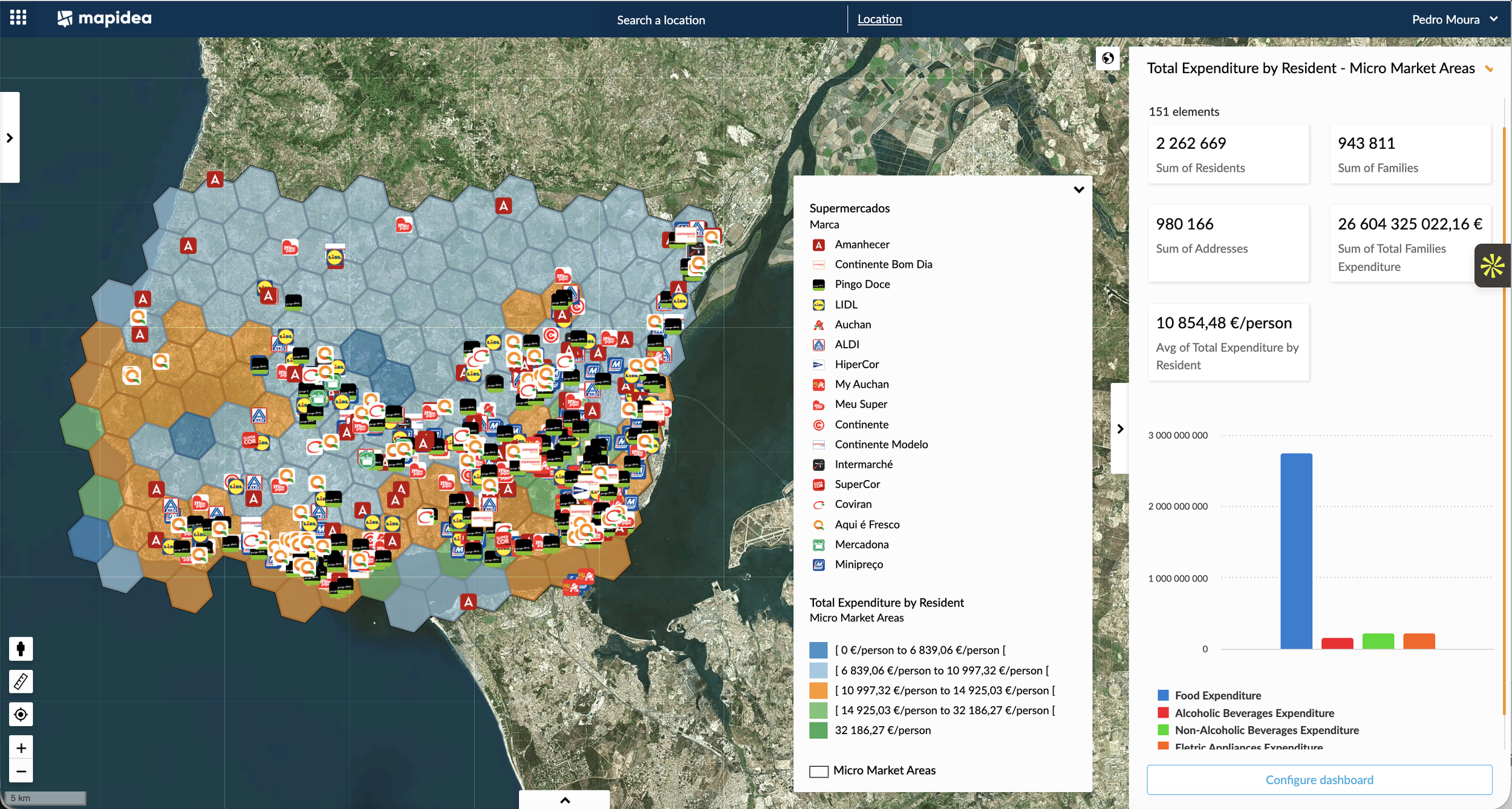
Micromarket analysis for a region (Lisbon, Portugal) with Purchasing Power (by some categories) and store landscape - Click image to see live report in Mapidea
What becomes possible
Instead of describing use cases abstractly, it’s easier to think about it like this:
Imagine that you could see your market share — not as a national number — but as a living map.
You know exactly where your brand is gaining, where it is losing, where competitors are advancing, and where the category is growing without you capturing it. And you can track how this evolves week by week.
You stop reacting late. You start acting early.
Imagine that you could move from “consumers somewhere” to “households in specific places.”
With access to address-level datasets, combined with sales potential and demographic profiling, you can define precise zones and know exactly which households fall within them. That opens a completely different level of activation: targeted sampling drops, localized promotions, product trial campaigns, or loyalty/club acquisition initiatives — all directed to clearly defined addresses.
Each interaction can be connected to a simple digital response (QR code, landing page, app), allowing you to capture engagement and tie it back to a specific location. Over time, you start building a real, geographically anchored consumer signal — not exhaustive, but continuously growing and directly linked to your actions.
You move from anonymous demand to measurable, local interaction.
Imagine that your conversations with retailers were no longer generic.
You walk in with a clear view of where your brand underperforms despite strong demand, where visibility should improve, where promotions make sense, and where local category dynamics justify action.
Category Management stops being a periodic exercise and becomes a continuous, locally grounded process.
This is not about better reports. It’s about a feedback loop.
The real shift is subtle, but powerful. You move from static insights to a continuous cycle: understand the market locally, act in targeted ways, measure results geographically, update your understanding, act again.
Over time, this builds something FMCG manufacturers rarely had: a living, evolving understanding of their consumers and categories.
Not perfect. Not complete. But precise enough to act — and improve — continuously.
The direction is clear
Mass-market strategies will not disappear. But on their own, they are increasingly:
costly,
slow to learn,
and inherently imprecise.
The future is not less data. It is better data, used at the right level: more granular, more frequent, more connected to action.
Geography is what makes that possible.
The next step
This shift does not require a long transformation program.
It requires putting in place a practical layer that:
integrates sales, category and competitor data;
structures it geographically;
keeps it updated over time;
and allows teams to act and measure locally.
This is exactly where Mapidea comes in.
With out-of-the-box solutions, manufacturers can combine internal data, external data such as NielsenIQ, demographic context and address-level datasets — and immediately start working at the level where the market actually exists.
No long, costly and frustrating projects. No heavy technical dependency. No black box.
Just a straightforward way to move from distance to understanding — and from understanding to action.
