
TL;DR — Store location decisions are still slow, manual or opaque. Mapidea’s Store Location Intelligence (SLI) lets you evaluate a site in minutes with transparent, customizable models — and then continuously track real performance to improve every future decision.
If store expansion matters to your business, reach out to test SLI with your own locations and data.
Store network expansion is one of the most critical decisions in any retail or service business.
Once a location is chosen and opened, it is not easy to roll back. The investment is significant, the operational impact is long-term, and a wrong decision can take years to correct.
And yet, the way these decisions are made today often falls into two extremes.
On one side, a manual, fragmented process: spreadsheets, scattered datasets, Google Maps, maybe a heavy and complex GIS tool (like ArcGIS or QGIS), manual analysis, PowerPoints, and a lot of experience-driven judgment. It works — but it is slow, inconsistent, and difficult to scale.
On the other, “magic black-box” tools: you input a location, get a score or a forecast — but with little visibility into how that result was produced. Hard to explain. Hard to trust. Hard to adapt to your business reality. And when customization is possible (like using your stores or customers data), it often comes with significant cost and complexity.
In both cases, something is missing: speed, clarity, and control.
A different approach: from analysis to decision, in minutes
After years working with companies like Domino’s Pizza, Adidas, Jerónimo Martins and others across retail, food, fuel and services, Mapidea has developed its first vertical module: Store Location Intelligence (SLI).
SLI is designed to do one thing well: turn location evaluation into a fast, structured, collaborative and explainable process.
Instead of building analysis from scratch every time, Mapidea SLI brings together a mix of key data layers needed to understand a location, like:
demographics and purchasing power
retail spend and market potential
points of interest, malls, supermarkets
mobility and footfall patterns
road networks and traffic
competitive landscape
market data such as NielsenIQ for category and product-level insights
and other relevant datasets.
All of this can be combined with the client’s own data:
existing store performance
sales by product/category
customer locations and behavior
From “where?” to “what happens if we open here?”
With Mapdea SLI, the process becomes radically simpler.
You point to a candidate location.
You click.
You get a spatially contextualized analysis of the area.
You get an estimate of business potential.
You adjust relevant parameters.
You get a structured, decision-ready report.
In minutes. Not days, not weeks.
And if needed, you can adjust parameters, test scenarios, and immediately see how results change.
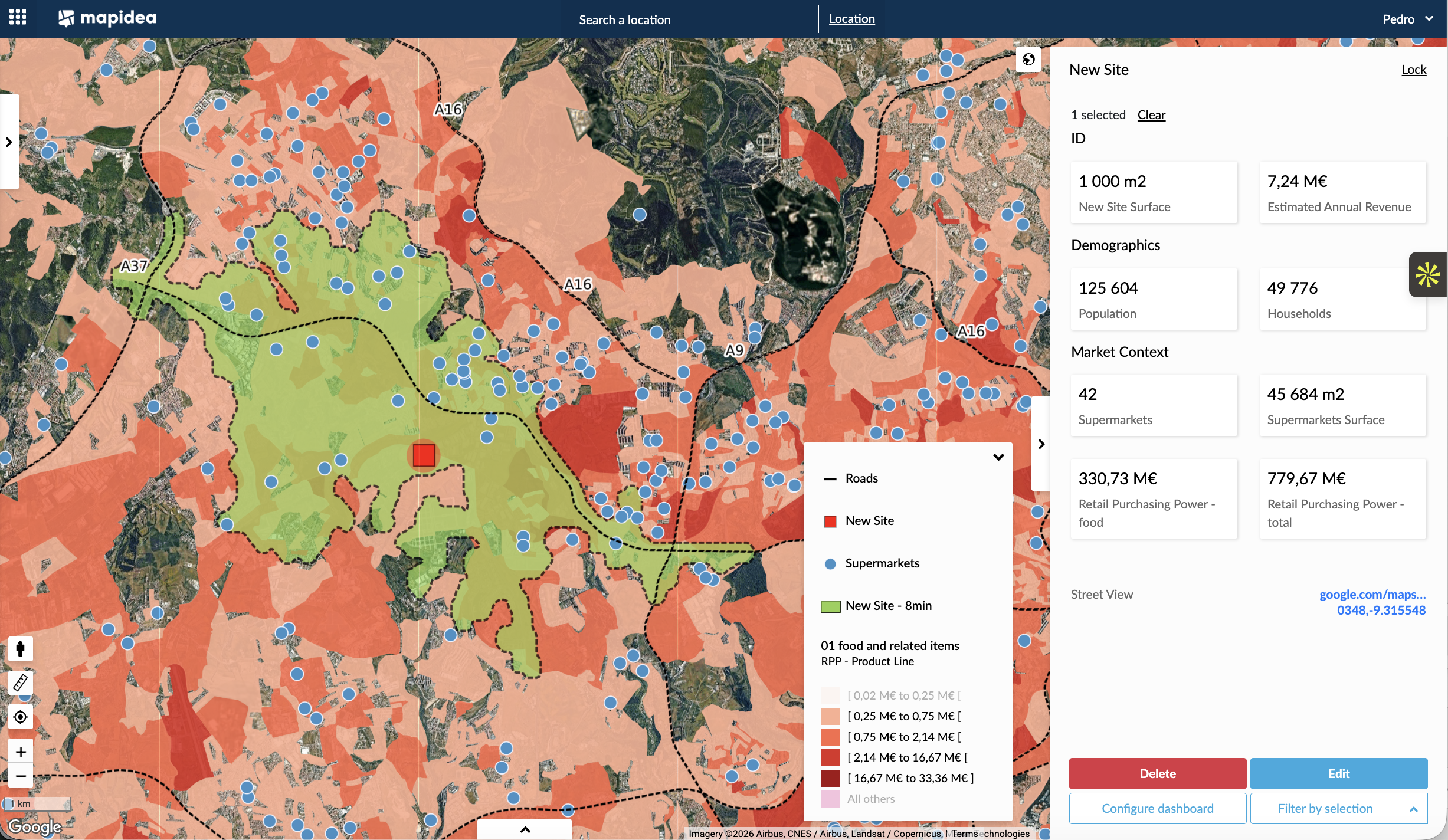
Mapidea SLI example - New Candidate Location for a Store revenue analysis after 1 click in the place
No black boxes. No magic.
One of the key design principles behind Mapidea SLI is simple: if you can’t explain it, you can’t trust it.
All models used to estimate potential are:
transparent
known
aligned with business logic
and fully customizable to match each organization specificities.
This means you don’t adapt your business to the tool: The tool adapts to your business.
From individual analyses to collaborative decisions
Another common issue in location decisions is fragmentation. Different teams working in parallel. Excel files, PowerPoints, screenshots. Uncountable email threads.
Mapidea SLI introduces a collaborative workflow logic, where expansion, real estate, marketing, finance and operations can work on the same analysis, within the same environment.
The result is not just faster analysis: it is a more aligned, more robust decision process.
And then comes the part most tools ignore
Most location tools stop at the location decision. Mapidea SLI doesn’t. Because the real value comes after the store opens.
Once a new unit is live, Mapidea SLI allows you to:
monitor its performance continuously
compare real sales vs estimated potential
identify under- and over-performance
understand why — geographically and contextually
and feed those learnings back into the model
Over time, this creates something extremely powerful: a self-improving location decision system.
Each new store is not just a bet. It is a learning input.
One module, multiple use cases
While Mapidea SLI is designed for new location decisions, its applications go further.
It can be used to:
benchmark existing stores against expected potential
identify underperforming units and diagnose causes
detect overperformers and replicate success factors
support network optimization and expansion strategy
Across industries:
food retail and supermarkets
QSR and restaurant chains
electronics and appliances
healthcare and beauty (including clinics and hospitals)
fuel stations and convenience networks
logistics and service networks
The shift
This is not just a new feature. It reflects a broader shift:
From slow, manual analysis → to immediate, structured insight
From opaque models → to transparent, controllable logic
From one-off decisions → to continuous learning systems
The next step
If store expansion is a critical part of your growth strategy, the question is simple: How fast, how consistently, and how confidently can you evaluate your next location?
With Mapidea’s Store Location Intelligence (SLI), the answer changes.
From weeks to minutes.
From guesswork to structured decisions.
From static models to continuous improvement.
Reach out to test Mapidea SLI with your own locations and data - and see how quickly you can turn a potential site into a confident decision.