
TL;DR: Healthcare is inherently geographic, from where patients live to where facilities operate. Combining healthcare spending and population data with a healthcare group’s own business data helps teams identify expansion opportunities, understand customers, focus marketing efforts and monitor performance across their network. Mapidea makes these insights accessible to business users, with healthcare spending data available for eight countries. Reach out to us for more details or access to the data.
Every healthcare business has a geography.
Its hospitals, clinics and laboratories are located somewhere. Its patients live and work somewhere. Its competitors operate somewhere. And the population, healthcare needs and spending potential around each facility vary from one place to another.
Yet geography is often treated as a secondary dimension—something to be considered when choosing a new location, or explored occasionally by a specialist team. The rest of the time, important decisions are made using spreadsheets, dashboards and reports that tell us what is happening, but not always where, or why it differs from one area to another.
For healthcare groups looking to grow and improve their performance, this is a missed opportunity.
What if geography were part of everyday decision-making across the organisation—accessible to the business teams responsible for expansion, operations, marketing, customer management and commercial performance?
A clearer view of healthcare markets
Healthcare markets are local. The potential around a facility depends on the people who can reach it, their characteristics, the services already available to them and the healthcare spending in that area.
A city or municipality average can conceal significant differences between neighbourhoods. Two potential locations just a few kilometres apart may serve very different populations and face different competitive environments.
That is why Mapidea has developed healthcare spending datasets for the United States, United Kingdom, Germany, Italy, Portugal, Spain, France and Mexico. These datasets provide a detailed geographic perspective on healthcare spending and can be combined with demographic information, the location of healthcare facilities and a company’s own business data.
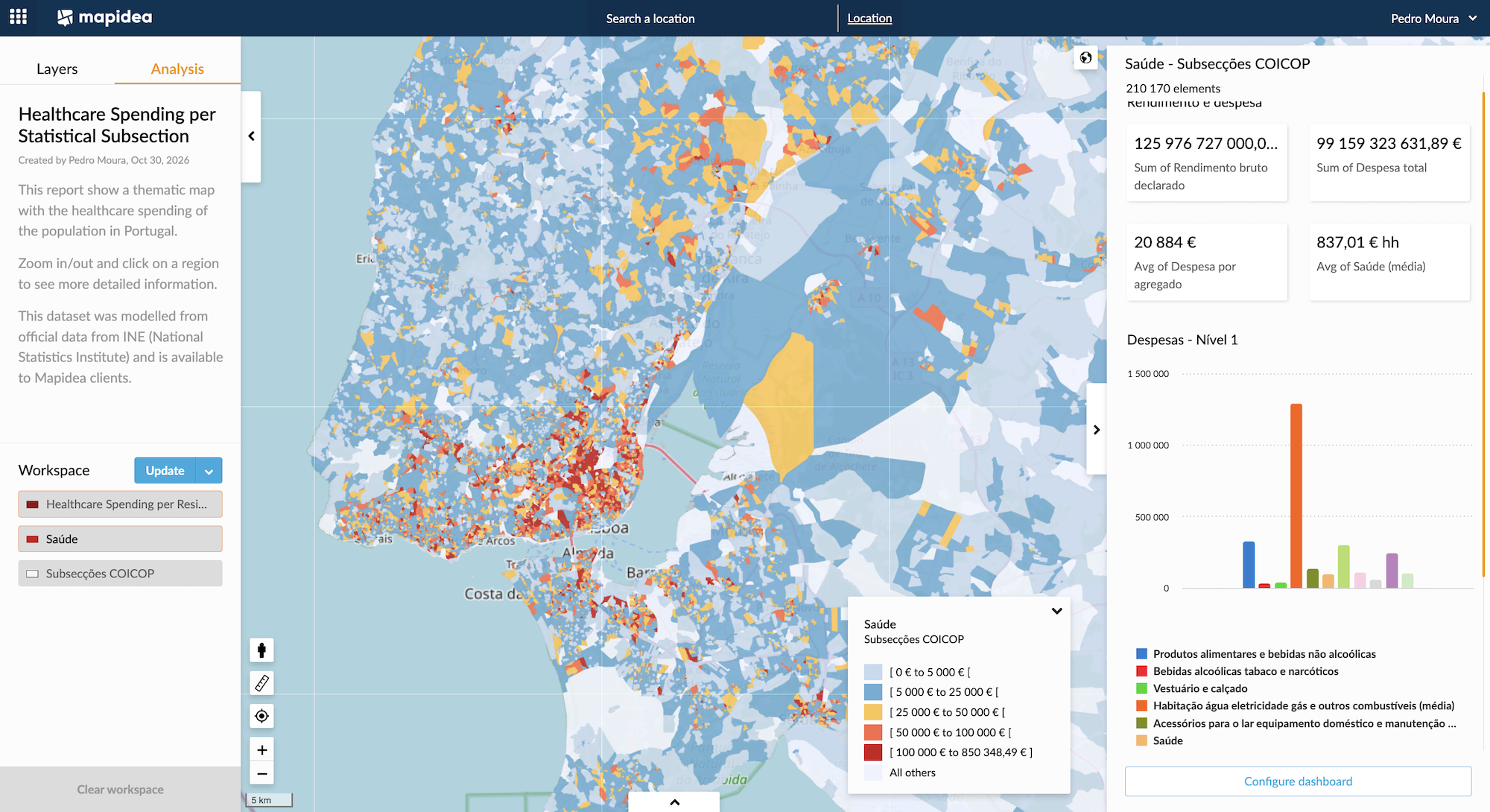
In Portugal, for example, healthcare spending can be analysed at the level of statistical subsections and visualised alongside hospitals, health centres and diagnostic laboratories. This makes it possible to explore how spending and the existing supply of healthcare services are distributed across the territory—and identify areas worth examining more closely.
From a location to its surrounding market
Looking at individual locations is just as important as understanding the wider territory.
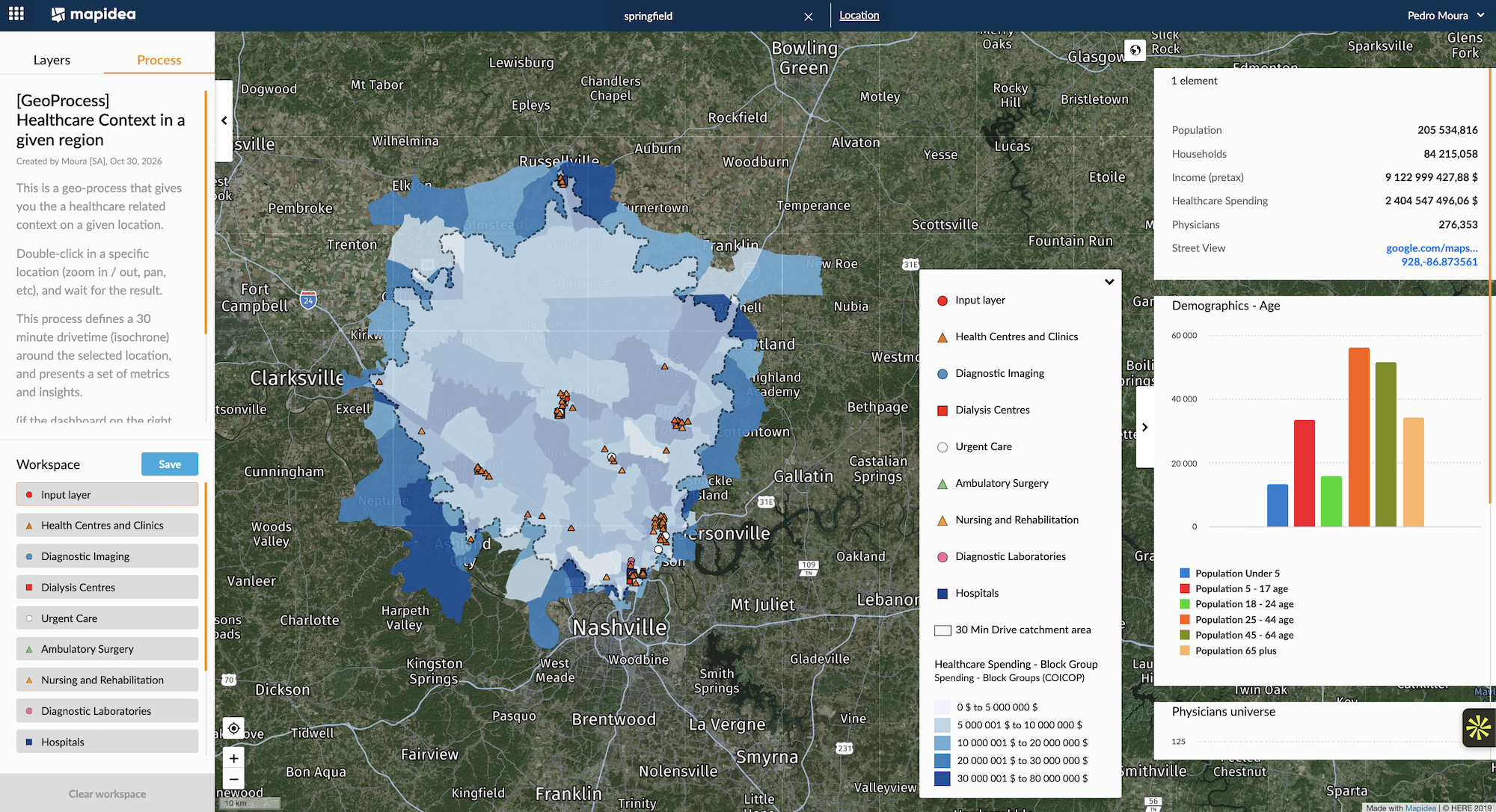
Imagine that your expansion team is considering a new clinic in the United States. Instead of looking only at a city average or drawing a simple radius around the proposed address, a business user can select the location in Mapidea and analyse the area reachable within 15 minutes of travel.
The analysis can bring together population, healthcare spending and other relevant indicators for that catchment area, helping the team compare possible locations and understand the market each one could serve.
The same approach can be used to assess existing facilities: What does the surrounding population look like? How does the local market compare with those of other facilities? Are there nearby services that should be considered?
Healthcare spending is one part of the picture. It should be considered alongside accessibility, the type of services offered, the existing healthcare network and the specific characteristics of each market.
Beyond expansion: geography across the organisation
The value of geographic analysis does not end when a new facility opens. Combined with regularly updated internal data, it can help healthcare organisations understand and improve their business continuously.
Expansion and network management. Compare potential locations, evaluate relocations or consolidations, and understand how facilities complement or overlap with one another.
Customer segmentation and profiling. Analyse where customers come from and how their geographic and demographic profiles differ across facilities, services or territories. Use those insights to better understand the communities each facility serves.
Marketing, acquisition and loyalty. Identify areas with potential to attract new customers, adapt communications to different local markets, and explore where stronger engagement with existing customers may be needed.
Market and wallet share. Compare the organisation’s activity with relevant indicators of local market potential. Where is performance strong? Where might there be an opportunity to reach more customers or offer more services?
Geographic performance monitoring. Follow sales and other business indicators across facilities and territories, identify geographic patterns, and investigate why results differ between apparently similar areas.
Each of these questions becomes more powerful when internal business data is brought together with external information on population, spending and the healthcare environment. Estimates of spending help describe market potential; the organisation’s own data shows how it is performing within that context.
Make geography available to the people making decisions
The greatest value comes when these insights are not confined to a one-off study or a specialist team. Expansion managers, marketers, commercial teams and executives should be able to explore their markets, ask questions and support their decisions with a shared geographic view of the business.
That is the purpose of Mapidea: to make location intelligence accessible to regular business users and connect internal and external data in a practical environment for analysis and decision-making.
Your facilities, customers, markets and results all have a geography. Is your organisation using that geography continuously, across the business?
If you would like more details about our healthcare spending datasets, access to the data, or a demonstration of how they can be used in Mapidea, reach out to us.
