
The US is a big market. That’s not a sales strategy.
TL;DR: A large market means little if your sales team cannot identify where to start and whom to approach. Using DE Saux, a fictitious German sausage brand, this example connects county-level market prioritisation with local retail prospects. Combining cultural affinity, household profile, income and distribution helps teams focus their effort. Mapidea makes that evidence easier to explore together, turning a national ambition into a practical commercial plan.
Your export plan says “United States”. Your sales team needs to know which buyers to call on Monday.
Between those two points sits a familiar gap. The market study looks promising. Someone knows a distributor. A trade show produces a list of contacts. Soon, the expansion follows whoever responds first, while more suitable markets remain unexplored.
For a company with limited sales capacity, that can become an expensive way to learn. Every low-priority visit uses time that could have gone towards a better prospect. The challenge is to concentrate effort where a credible audience and a viable route to market come together.
A familiar product still needs a route to the shelf
Consider DE Saux, a fictitious German sausage brand building US retail distribution. Its heritage offers a plausible starting point: communities with German ancestry may provide cultural familiarity. But ancestry alone cannot establish demand, and a promising audience is difficult to reach without appropriate retailers.
The demonstration brings four dimensions into a county-level comparison:
Cultural affinity combines the number and share of residents with German ancestry, balancing market size with concentration.
Household profile considers family numbers, family size, families with children and educational attainment. The preference for larger, more educated family households is an illustrative positioning assumption, to be tested commercially.
Income combines median household income with the share of households earning at least $100,000 a year, adding context for the brand’s price positioning.
Distribution potential considers relevant retail establishment counts and their density relative to households, indicating the presence of possible routes to consumers.
The demographic measures come from the US Census Bureau’s 2020–2024 American Community Survey. County Business Patterns supplies the national retail counts, while Overture Places supports the local outlet search. The county measure is a broader retail proxy; individual prospects need a closer assessment of product fit.
The highest percentage may be the wrong starting point
Imagine a small county with a high proportion of residents reporting German ancestry. A larger county could have a lower proportion but many more such residents, alongside a wider retail network. Which offers the more practical launch market?
That depends on the commercial plan. A focused specialist launch and a broader supermarket rollout need different combinations of audience, scale and distribution. Looking at percentages alone can hide that trade-off; looking only at population can hide it too.
In this example, each dimension becomes a 0–100 index and contributes 25% to the composite opportunity score. The weights are configurable. The score creates a shortlist for investigation, with the underlying values explaining why each county deserves attention. It is neither a sales forecast nor proof of product demand.

[Image 1] US county comparison: the composite opportunity score alongside German ancestry, household profile, income and retail distribution indicators. - Click for live analysis
A priority county is not yet a prospect list
Selecting a market is where the sales work becomes more specific. Within a shortlisted county, DE Saux can explore supermarkets, delicatessens, specialist food shops and meat retailers, assessing their location and surrounding market context.
The local view helps identify clusters worth investigating and build manageable prospecting territories. Where demographic estimates are shown at block level, they are derived from larger Census areas; finer map detail does not mean every value was measured at that scale.
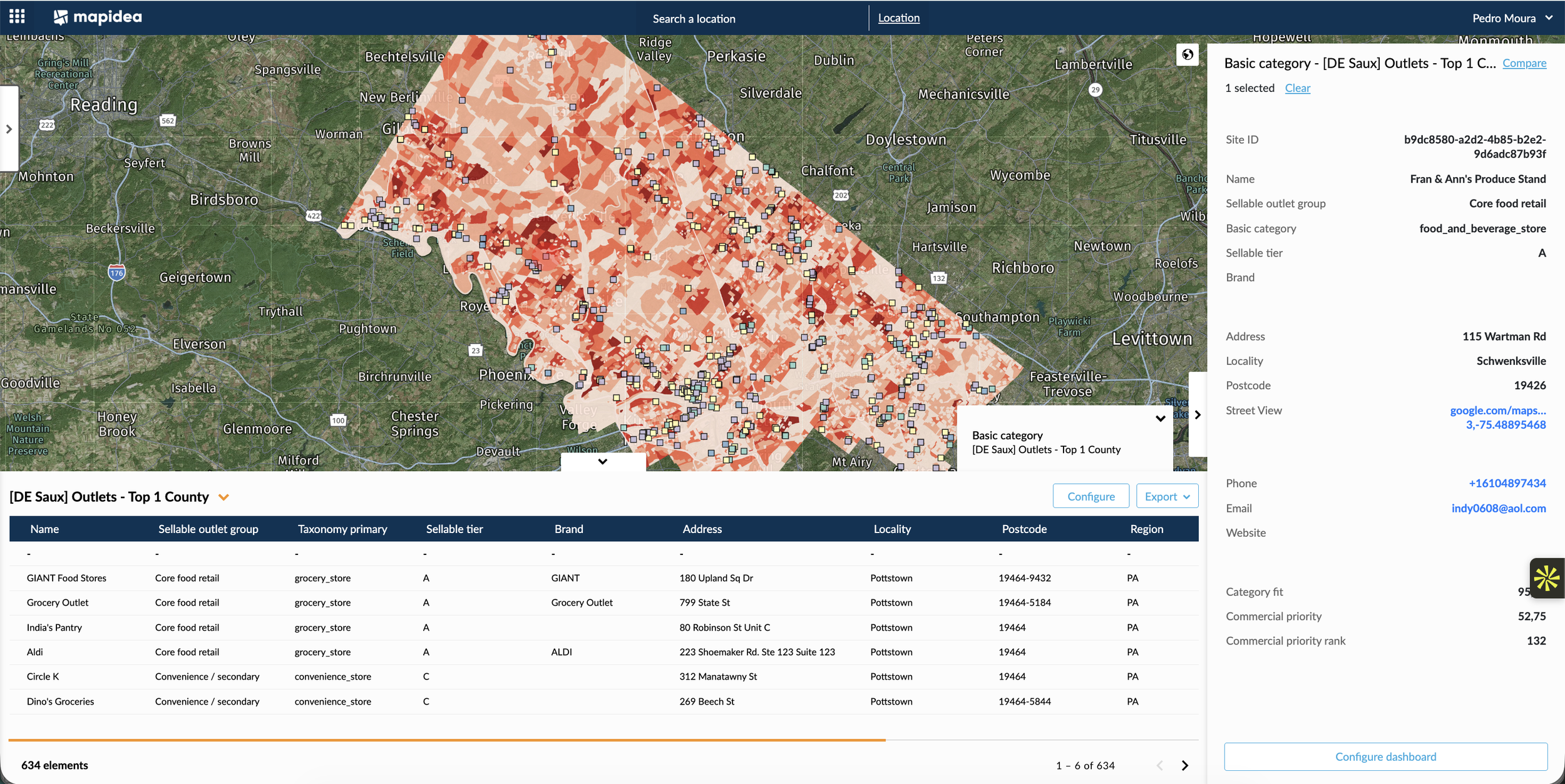
[Image 2] Local prospecting: potential retail outlets within the selected county, shown against the surrounding market profile to support a focused commercial shortlist. - Click for Live Analysis
Each shortlisted outlet should lead to a concrete next step: check its assortment, establish who buys the category, assess supply requirements and identify the right contact. A chain branch may be a useful distribution location while purchasing decisions sit at headquarters. A nearby independent deli may offer a more direct conversation.
This is where territory planning and lead generation meet. Sales can organise outreach around commercially coherent areas, while marketing prepares relevant support. The resulting list contains potential stockists, with suitability and willingness to buy still to be confirmed.
Give the sales team the reasoning as well as the list
In Mapidea, strategy, marketing and sales can explore the same counties, inspect indicators and move into outlet-level detail without each team rebuilding the analysis. A sales manager can challenge a market priority using local knowledge; colleagues can see what evidence supports the alternative.
That accessibility matters when the next question arrives during a meeting. Comparing another county or narrowing the outlet categories should not require a fresh technical project. Reusing the analysis reduces preparation time and manual effort, while visible criteria and consistent calculations improve the speed and accuracy of prioritisation.
The first orders should change the next decisions
Once distribution starts, bring commercial results back into the geographic view. Where are prospects converting into active stockists? Which outlets reorder? Where is sales performance weak despite apparently favourable market conditions?
A high-potential county with few active accounts may need more coverage. A well-covered county with weak repeat orders may need attention to assortment, pricing or activation. Tracking those differences over time helps direct visits and local campaigns, and tests the assumptions behind the original ranking.
The approach applies to other food and beverage brands, specialist FMCG suppliers and wholesalers. The relevant audience and channels change, but the commercial question remains practical: where should the next hour of sales effort go?
Before approving “US expansion”, ask your team to show the priority territories, the next prospects and the evidence behind both. A country name belongs in the ambition. A sales plan needs somewhere to start.
