
Have You Ever Mapped Your Clients?
Let me be blunt: if you don’t map your clients, you’re running your business blind in space. You have data -sure- but it’s fragmented. Disconnected. Static. You probably know who your clients are, but not where they are, how they behave, or what your business looks like on the ground.
Think about it: if you could see your clients on a map tomorrow, with hotspots glowing where your business is thriving and cold zones where it’s shrinking, what would you do differently? That’s exactly the kind of insight you’re missing today.
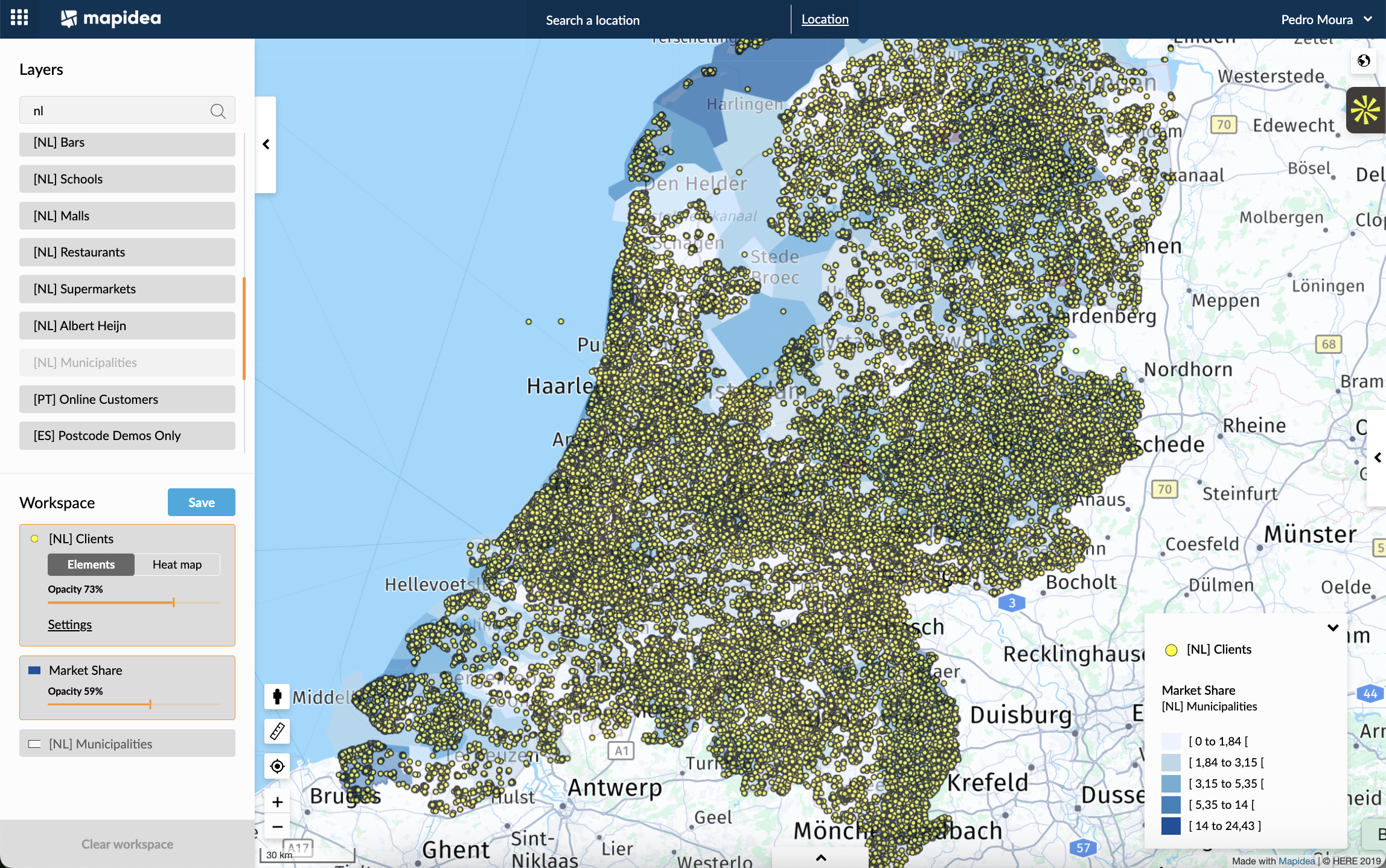
Map of clients in Netherlands, overimposed on a regional market share thematic map (example data)
The Real Opportunity Cost of Ignoring Geography
Here’s a brutally honest list of what companies lose when they ignore the geographical dimension:
Market share blind spots: You don’t know which regions are saturated, which are growing, or which are slipping into competitors’ hands. (Imagine a map colored by market share, red zones shrinking, green zones booming.)
Unequal contribution: Some neighborhoods punch above their weight; others underperform. Without geography, you treat them all the same. (Picture a dot map with each client weighted by revenue.)
Shifting client value: Areas that were gold mines last year may be declining this year. You’re blind to trends.
Service quality gaps: Complaints, returns, or churn are not random-they often cluster geographically. If you don’t see this, you can’t fix it efficiently. (A heat map of customer issues can reveal patterns instantly.)
Marketing & sales impact: Campaigns don’t perform uniformly. Some areas respond like magic, others ignore you. Without mapping, you’re wasting resources. (Overlay campaign reach and conversion maps.)
Competitive pressure: Competitors move regionally. Without a map, you can’t anticipate their attacks or defend your turf.
Geo-demographics & economics: Age, income, household type, spending habits-they all vary by location. Not using this info is like flying blind. (Layer client data over demographic maps for instant insight.)
Offline & online behaviors: Store visits, app activity, web purchases-all tell a story by location. Missing it? Missing opportunities.
Hidden opportunities: Where could you expand stores? Where could upsells work best? Where should marketing target next? Without a map, these questions remain guesses.
In short: every day without a client map is value left on the table.
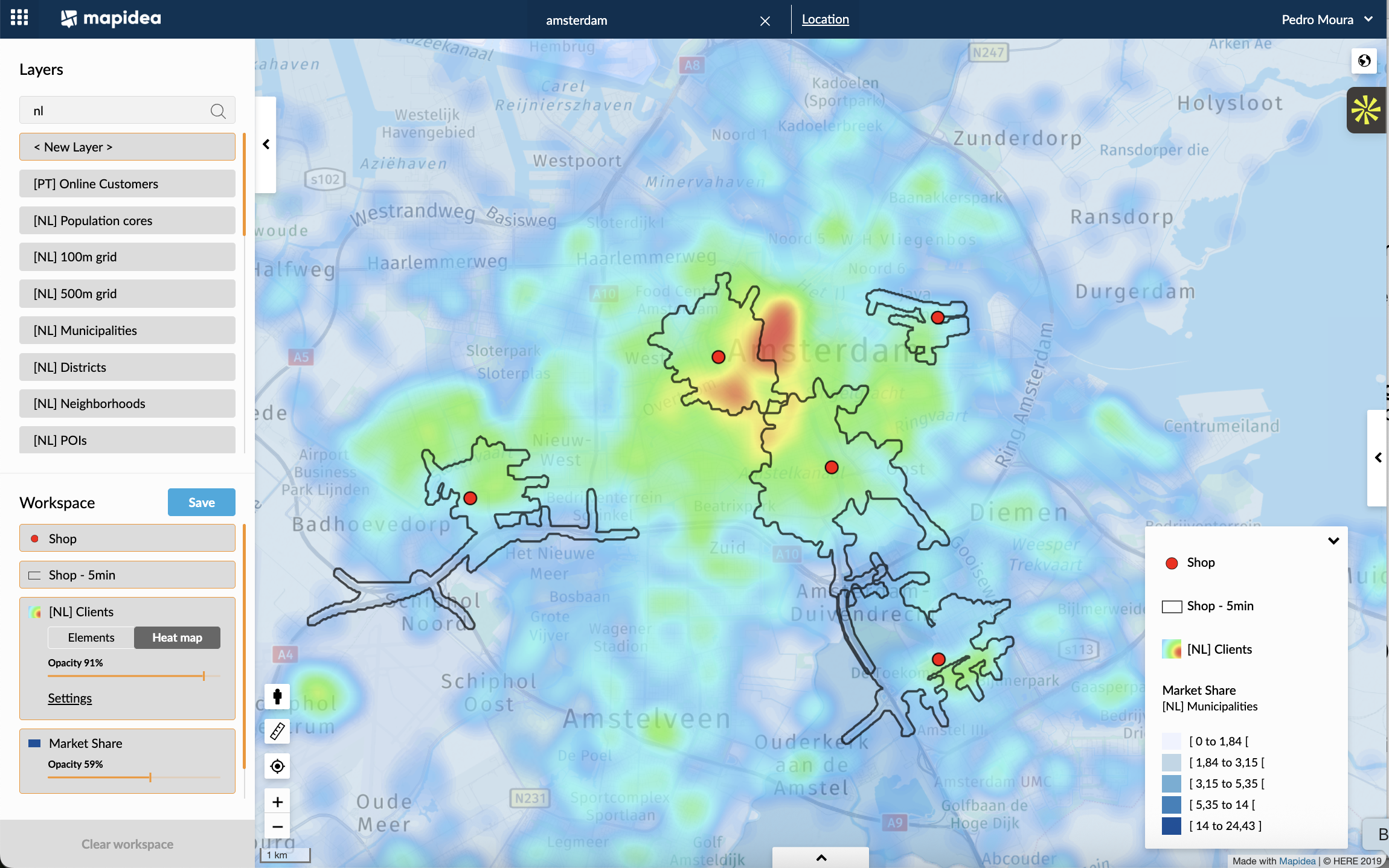
Map of clients geographical distribution intensity, shops and 5 minute drivetime areas (Isochrones) around shops (example data)
How to Actually Map Your Clients
It’s simpler than it sounds. The key steps:
Make geography explicit:
Georeference client addresses into coordinates.
Capture location data from apps, websites, and store visits.
Combine with other datasets: economic, demographic, mobility. (Think of layering maps like Photoshop: client dots, household income, foot traffic-suddenly patterns emerge.)
Give teams access:
Marketing, sales, and operations teams need tools to see, interact, and act on the data.
Tools like Mapidea let you blend datasets, visualize patterns, and generate insights that were invisible in spreadsheets.
Integrate continuously:
Update client locations and behaviors automatically.
Make geography a living, breathing dimension in your decisions.
Support a closed-loop: analyze → decide → execute → optimize.
Where to Begin
Start smart. Start small but visual:
Quick win: Map your existing clients and overlay one additional dataset (revenue, campaign response, churn, etc.). Pick a clear goal:
Understand market share by region.
Design acquisition or upsell campaigns.
Optimize your store network.
Profile e-commerce clients.
(Imagine a simple dashboard: dots for clients, shaded areas for performance. Insight hits you at a glance.)
Expand scope: Add more data layers, automate updates, integrate continuously. Let insights guide campaigns, store planning, or operational improvements.
Iterate continuously: Geography isn’t static. Keep refining, mapping trends, spotting opportunities, defending against competitors, and uncovering value you didn’t even know existed.
The technology exists. The data exists. The missing piece? You. Stop guessing. Stop relying on gut instinct. Start putting your clients on the map-literally-and watch opportunities unfold, visually and strategically.
So again, I’ll ask: have you ever mapped your clients? Or are you happy running blind?