
But, man, eCommerce IS geographical!!
⚠️ Long read ahead - but if eCommerce is a meaningful part of your business (and especially at Christmas), believe me it’s worth your time.
TL;DR
eCommerce does not happen in a locationless internet.
People buy from real places, behave differently depending on where they are, receive deliveries in specific contexts, and experience service quality geographically. As eCommerce keeps gaining weight versus offline retail in Europe and the US, managing it without geography becomes increasingly expensive.
In Part 1, I explain why eCommerce is objectively geographical.
In Part 2, I share a practical cheat sheet on how Geographical Intelligence can be used today to improve eCommerce performance, marketing efficiency, market share analysis, and customer experience.
Part 1 - Why eCommerce is Geographical (Whether You Like It or Not)
It’s Christmas season. Peak demand. Peak expectations. Peak pressure. For many companies, these weeks don’t just close the year - they define it.
And every year, the same misconception resurfaces: that eCommerce somehow exists outside geography, floating freely in a borderless internet.
It doesn’t.
eCommerce is deeply, objectively, unavoidably geographical.
And peak season simply makes that fact impossible to ignore.
People don’t buy online. They buy from somewhere.
Every search, click, and purchase happens in a physical context: at home, at work, in transit, in dense cities, suburbs, or temporary holiday locations.
And geography shapes behavior:
different regions buy at different times
neighborhoods show different price sensitivity
product preferences vary spatially
mobile vs desktop usage changes by area
conversion, basket size, and churn follow geographic patterns
Aggregated dashboards flatten these realities. Maps expose them.
Once you see your eCommerce customers on a map, you stop asking “how are we doing?” and start asking “where are we winning - and where are we not?”

Map of eCommerce orders by Postal Code in Germany (Mapidea, example data)
Christmas doesn’t change behavior. It reveals it.
Peak season doesn’t create patterns - it amplifies them.
Under pressure, geography becomes visible:
some zones overperform massively
others stagnate despite similar campaigns
promotions resonate differently by area
These aren’t anomalies. They’re market structures finally exposed.
Online and offline form one geographical system
Christmas shopping makes this painfully obvious.
Customers browse online, check stores, buy online for someone living elsewhere, collect near work, return near home.
These are geographical journeys, not channel journeys.
Mapping these flows reveals:
where physical presence boosts online sales
where click & collect truly adds value
where proximity to stock matters
how space shapes omnichannel behavior
eCommerce is now too big to manage blindly
Over the last decade, eCommerce has evolved from an “alternative channel” into a structural pillar of retail and services.
Across Europe and the US:
online penetration has grown steadily year after year
growth consistently outpaces offline
in many categories, eCommerce represents a decisive share of sales
peak seasons increasingly determine annual results
At this scale, misallocation hurts fast.
When eCommerce grows, geography matters more - not less.
Market share, penetration, and growth are geographic
Your eCommerce performance isn’t uniform across territory.
When you map clients, orders and transactions and blend them with socio-demographics, competition, mobility, or market data (like NielsenIQ), you suddenly see:
where you dominate
where competitors are quietly winning
where penetration is low but potential is high
where growth will realistically come from
You don’t have one eCommerce business. You have many micro-markets.
Marketing always has a geography
Every “online” campaign lands in physical places.
Search demand, conversion, CPA, ROAS - all vary geographically, structurally, not marginally.
Mapping campaigns allows you to:
understand where marketing truly works
detect saturation vs opportunity zones
measure real impact geographically
move from execution to spatial decision-making
Service quality has a geography too - but it’s only part of the picture
Deliveries, returns, complaints, and NPS cluster geographically.
Mapping service metrics helps you:
detect problematic zones early
compare carrier performance by region
protect high-value areas from erosion
But service quality is one dimension of a broader spatial reality - not the whole story
The conclusion of Part 1
The internet may be global. But eCommerce is local.
If eCommerce weren’t geographical, your demand, growth, campaigns, problems, and opportunities wouldn’t all draw the same thing: a map.
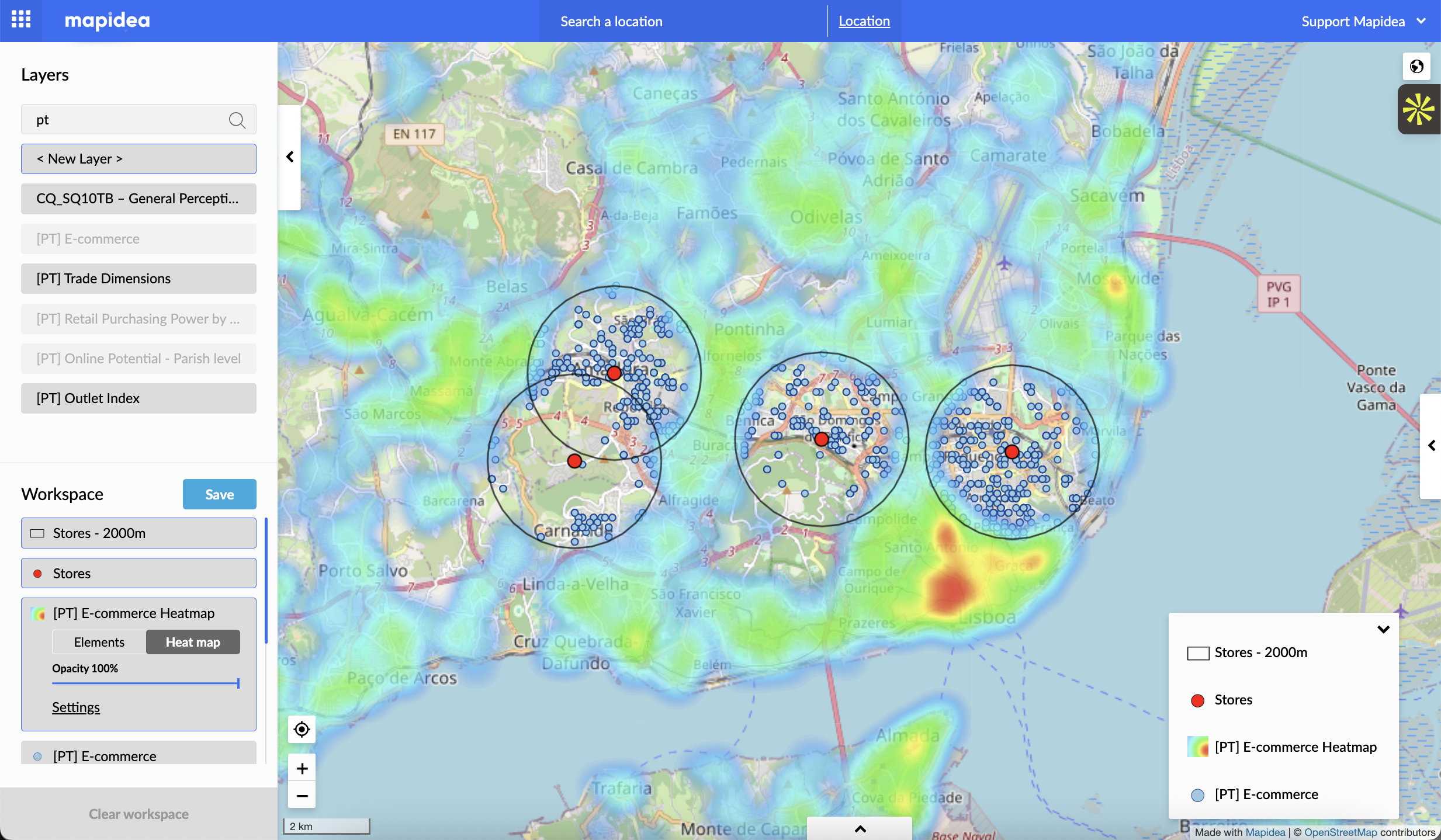
eCommerce orders intensity outside store influence areas and Orders near stores in Lisbon region (Mapidea - example data)
—————————————————————————————
Part 2 - A Practical Cheat Sheet to Boost eCommerce with Geographical Intelligence
If Part 1 explains why geography matters, Part 2 answers the obvious question: what do you actually do with it?
Here’s how companies pragmatically start using Geographical Intelligence to improve eCommerce.
1. Map your eCommerce customers - first
Georeference your customers and visualize them. Weight them by revenue, frequency, basket size, churn, or lifetime value.
This alone shows:
where value concentrates
where growth stalls
where averages hide extremes
2. Understand market share and penetration geographically
Blend client data with:
population and household data
socio-demographics
category or market datasets
You can now identify:
underpenetrated regions
overperforming clusters
realistic expansion zones
3. Make marketing spatial
Map campaigns by area:
impressions, clicks, conversions
CPA and ROAS
before/after exposure
Geography becomes your impact assessment layer.
4. Segment customers by place
Postal codes cluster behaviors.
By blending geo-demographics with transactions, you can:
tailor offers locally
adapt messages
personalize at scale
5. Optimize omnichannel geographically
Map online sales together with:
stores
click & collect
returns and showrooming
This reveals how physical networks support digital performance.
6. Monitor service quality where it matters most
Map delivery time, complaints, and returns.
Fix problems where impact is highest, not where noise is loudest.
7. Close the loop
Analyze spatially.
Decide geographically.
Execute locally.
Measure impact on the map.
Repeat.
The final word
You don’t need more data.
You don’t need more complex dashboards full of hard to understand data. You don’t need to see you geographical eCommerce data in a data table or in a chart.
You need to look at what you already have - on a map.
Because the moment you do, eCommerce stops being abstract and starts behaving exactly like what it is: a geography-driven business engine - that just happens to run online.
Shoot me an email if you want to share some ideas or thoughts or this, or know more about how Mapidea can help you boost your eCommerce using Geography.
